
TESLAbikář Episode 25 - Li-Fi: When Light Transmits Data
Imagine that your ceiling light not only illuminates the room but also transmits data at speeds exceeding typical Wi-Fi connections. This is exactly what LiFi (Light Fidelity) technology, introduced by Professor Harald Haas at a TED conference in 2011, enables.
What is LiFi?
LiFi is a technology that uses visible light to transmit data. It works on the principle of very fast flickering of LED diodes (so fast that the human eye cannot perceive it), which creates a binary code – similar to Morse code, but incomparably faster. While regular Wi-Fi uses radio waves, LiFi operates with the visible light spectrum.
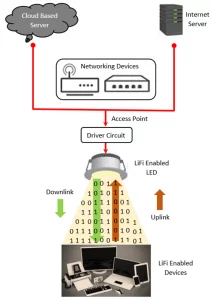
Advantages of LiFi
- SecurityLight doesn't pass through walls, so data remains in the room
- SpeedTheoretical speed up to 224 Gb/s (significantly faster than regular Wi-Fi)
- No interferenceDoes not interfere with radio waves, ideal for hospitals or airplanes
- UbiquityUtilizes existing lighting infrastructure
- EcologyLower energy consumption than Wi-Fi
Disadvantages and limitations
- Requires a clear line of sight between the transmitter and receiver
- It doesn't work with the light off (can be solved with infrared light)
- So far, higher initial costs
- Limited signal range
Practical use
LiFi finds application primarily in environments where Wi-Fi is unsuitable or prohibited, or where maximum data security is required:
- Hospitals and healthcare facilities
- Aircraft and the aviation industry
- Industrial plants with sensitive instruments
- High-security military applications
- Underwater communications (light travels better in water than radio waves)
Comparison with Wi-Fi
| Parameter | LiFi | Wi-Fi |
|---|---|---|
| Speed | up to 224 Gb/s | commonly <1 Gb/s |
| Security | Very high | Standard |
| Range | about 10 meters | 30+ meters |
| Wall permeability | No | What |
| Wave interference | Minimum | Average |
The future of technology
LiFi has the potential to revolutionize the way we access wireless communication. With the growing number of connected devices and increasing demands for data transfer speed and security, LiFi could be a key technology of the future. Pilot projects are already underway in office buildings, schools, and hospitals, demonstrating the practical applications of this innovative technology.
Although LiFi will likely not completely replace Wi-Fi, it can serve as an excellent complement, especially in environments requiring high security or where radio communication is problematic.